Scalable, Modular, Future-Ready System.
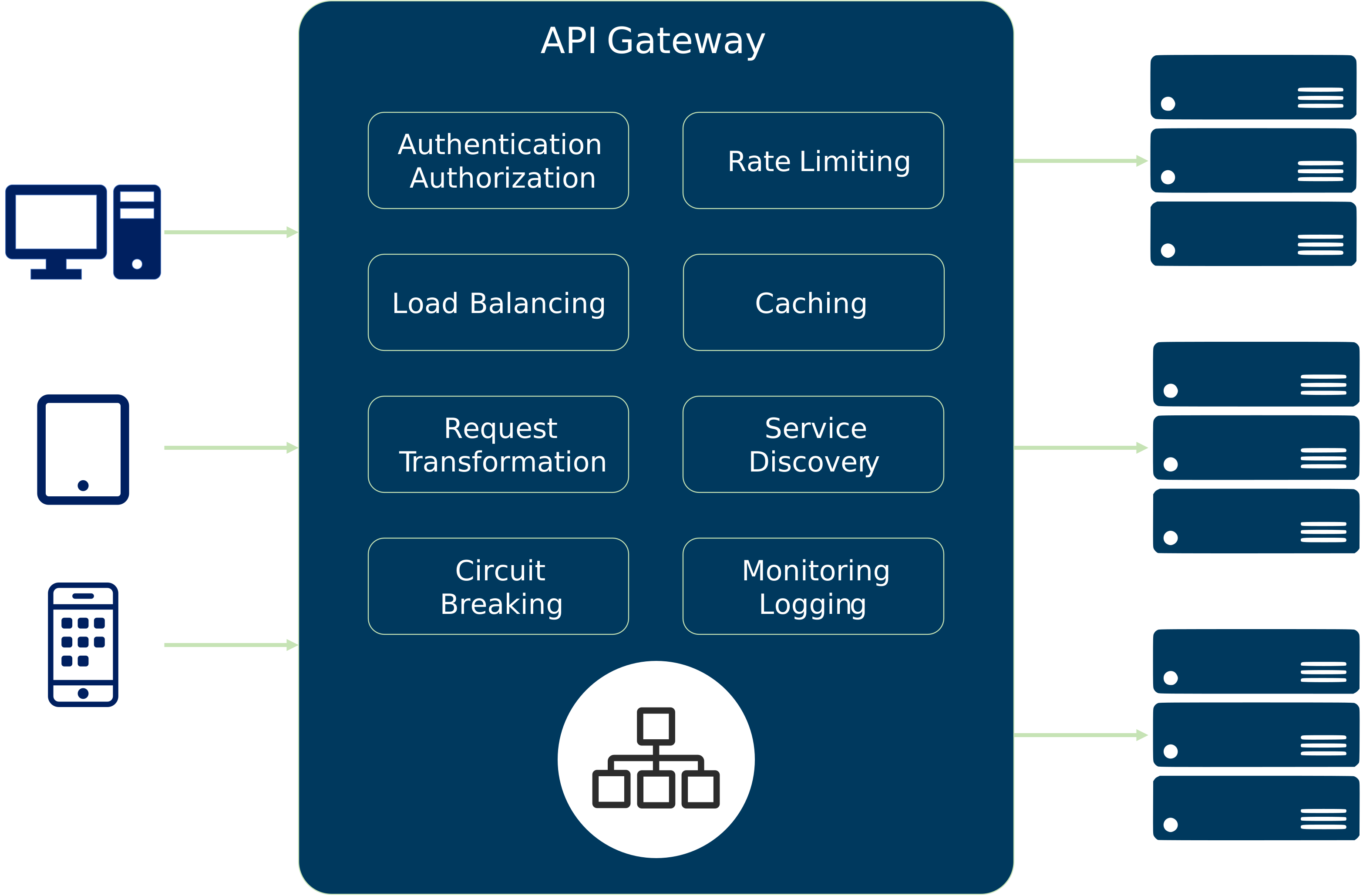
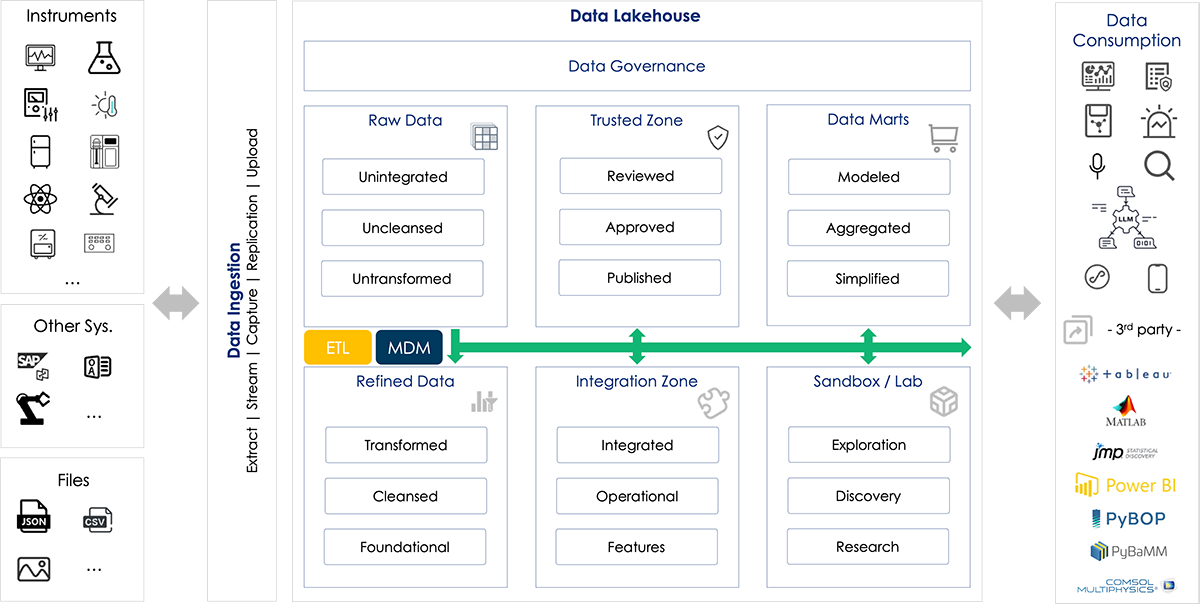
Our system architecture is built on a robust six-layer design that ensures high performance, seamless integration, and resilient scalability across complex industrial and laboratory environments.


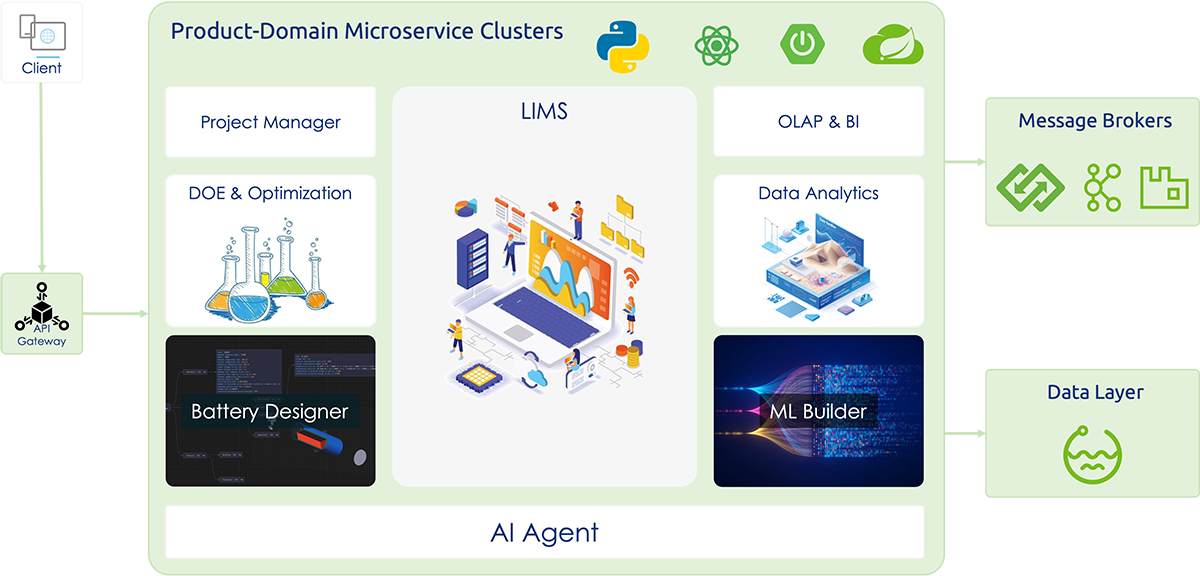
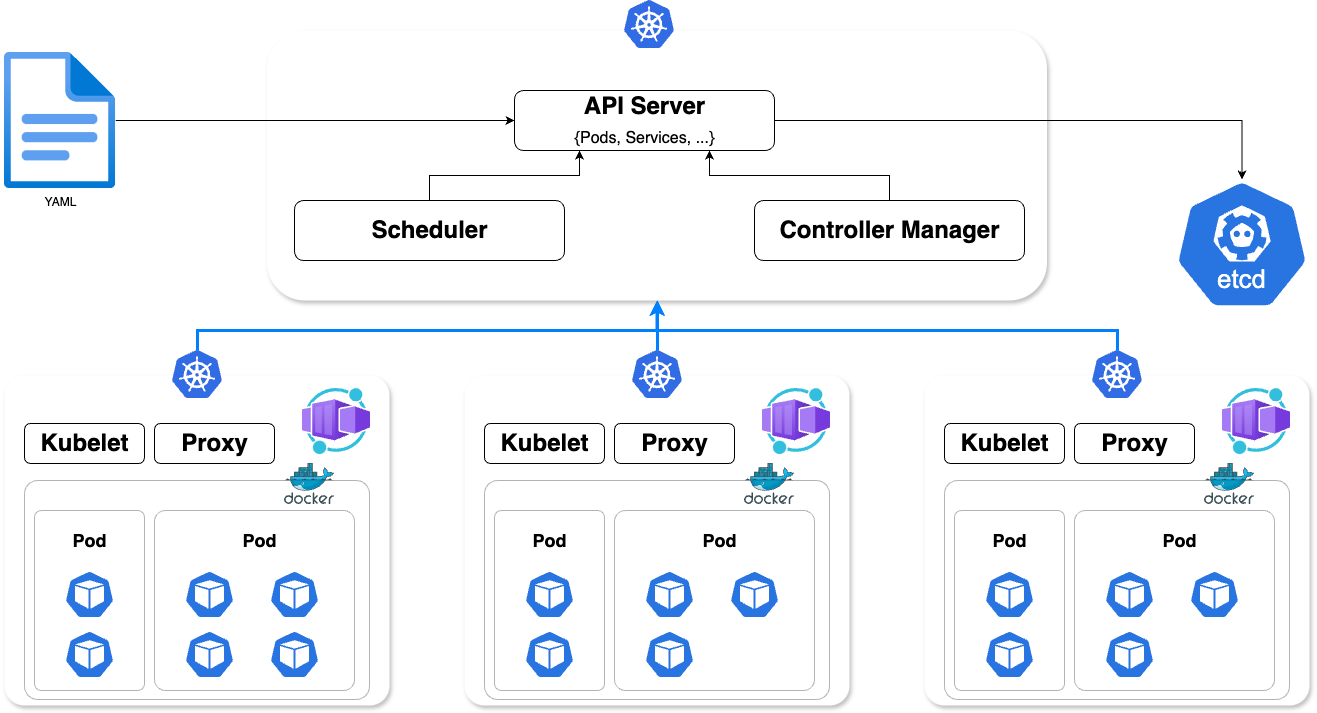
Intelligent Microservice Architecture for Future-Oriented Battery Innovation
This architecture integrates domain-specific microservices under a unified, AI-empowered digital framework, enabling agile battery R&D, high-throughput testing, and data-driven decision-making. From laboratory information management to optimization, machine learning, and real-time analytics, every module is designed for scalability, modularity, and continuous intelligence—supporting next-generation energy technologies with unmatched digital capability.

LIMS : the Orthogonal Basis
The digital backbone of lab operations, LIMS connects project planning, design, and post-analysis modules. It enables full lifecycle management of samples, workflows, devices, and data, forming a closed-loop control system for lab activities.
Features
Rescources / Workflow / Data Acquisition / Data ETL
Technologies
Spring Cloud / IoT / Workflow Engine / Rules Engine / Containerization

Deep Domain Expertise

Proven at Scale

Modern & Modular Architecture
AI-Powered Intelligence
Structured Coordination for Pre-Experiment Design
By integrating project planning, DOE, and battery designer platforms, this dimension extends the LIMS core to cover structured task generation and parametric mapping. It establishes a digital twin of experiment intent before execution, ensuring high-efficiency orchestration and robust traceability across all upstream processes.
Project Manager - R&D Planning Kickoff
An integrated project management engine tailored for battery R&D workflows, covering project initiation, task decomposition, resource allocation, and progress tracking. Supports task-driven orchestration and automatic linkage to experimental tasks in LIMS.
Features
Collaboration and Permission Hierarchy / Gantt Chart & Milestone-based Planning / Version, Resource, and Progress Tracking
Technologies
BPMN / Spring Boot

Experiment Design - Parameter Space Planning
The digital backbone of lab operations, LIMS connects project planning, design, and post-analysis modules. It enables full lifecycle management of samples, workflows, devices, and data, forming a closed-loop control system for lab activities.
Features
Rescources / Workflow / Data Acquisition / Data ETL
Technologies
Spring Cloud / IoT / Workflow Engine / Rules Engine / Containerization
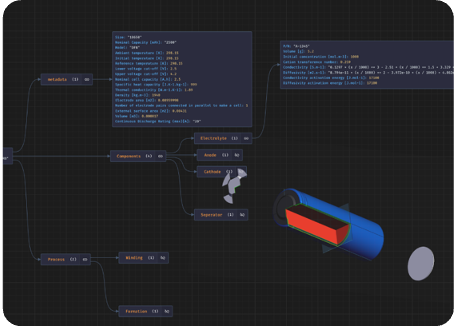
Battery Design - Modular Digital Twin Foundation
Supports layered modeling from materials to electrode structure and process parameters. Provides modular, reusable, and version-controlled configuration capabilities, forming the basis for traceability and design-experiment linkage.
Features
Model Based System Engineering / Integration / Recipe Comparison
Technologies
Foundamental Electrochemistry / DSL Interpreter / Version Tracking / Python
QuaNode – Edge Intelligence Node
The First Gateway for Device Integration, Feature Processing, and Edge Diagnosis
QuaNode is a powerful edge computing unit designed for battery testing labs and production environments. It connects seamlessly with diverse testing devices via common IoT protocols, translating vendor-specific commands into unified workflows. Equipped with local data processing, it performs feature extraction, anomaly monitoring, and diagnostics directly on the edge, ensuring low-latency insights and high resilience. Models trained from full-scale cloud data can be deployed back to QuaNode, enabling real-time inference and continual improvement at the edge—thus forming a closed-loop intelligent quality system from data acquisition to autonomous decision-making.

Deep Analytics & Insightful Decision Support
Leveraging LIMS-collected data, this axis expands the post-experiment value chain through OLAP, statistical analytics, and machine learning. It drives value realization from raw data to decision-grade insights, enabling anomaly detection, causal analysis, and predictive modeling in a closed feedback loop.
OLAP&BI - Business Insight & Management Support
Provides multidimensional data modeling and analysis for projects, products, and experiments. Delivers real-time dashboards, KPI monitoring, and anomaly alerts to support transparent business operations and data-driven decisions.
Features
Pivot / Anomaly / Customizable Dashboards
Technologies
Meta Data / OLAP Engine / Visualization / Data Streaming
Data Anlytics - Data Science & Knowledge Engine
Performs high-dimensional statistical and physical modeling on raw experimental data. Supports feature engineering, hypothesis testing, and variable attribution to uncover performance-driving factors and assist in root cause analysis.
Features
Data Cleansing and Normalization / Clustering / Correlation / Decomposition / Statistics
Technologies
Data Science Stack / Modeling / Visualization

ML Builder - Predictive Model Generation
A low-code platform for building, training, validating, and deploying machine learning models. Supports use cases like life prediction, anomaly detection, and state estimation with full lifecycle model management.
Features
Regression / Classification / Time-Series Modeling / Model Explainability / No-Code
Technologies
Algorithm / Model Reuse / Model Management
These numbers come from just one of our clients.
connected in real time
managed across full lifecycle
securely stored and orchestrated
AI Agent - Workflow Orchestrator with Embedded Domain Intelligence
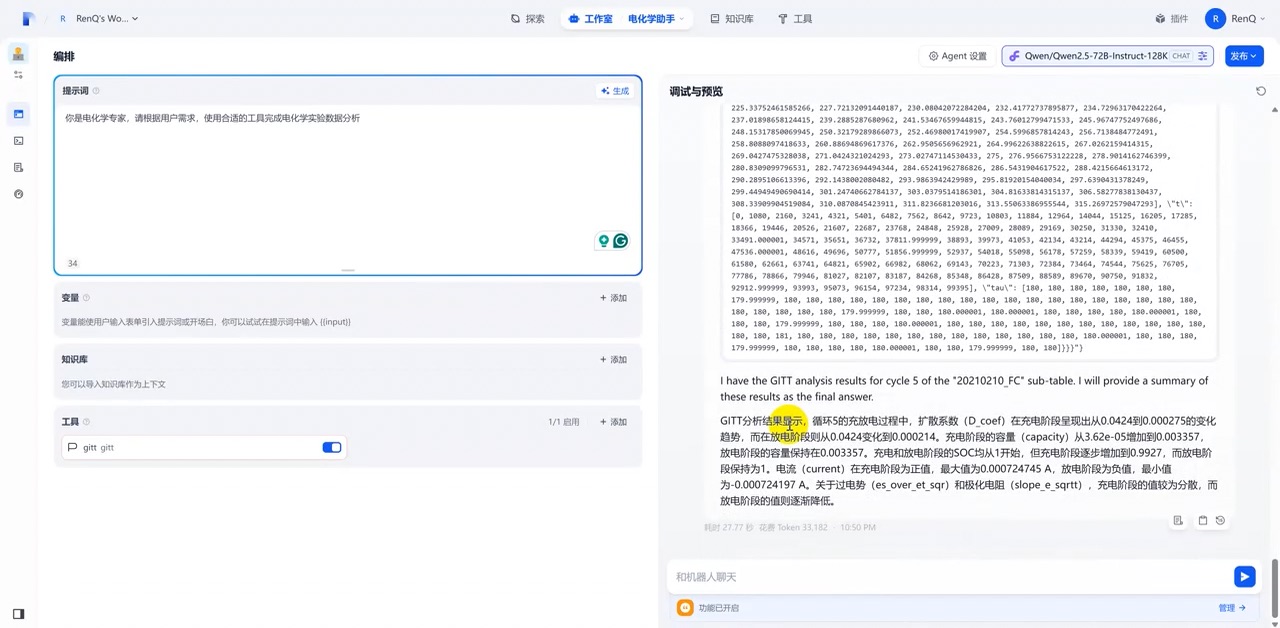
The AI Agent is not just a general-purpose LLM assistant, but an orchestrator that embeds domain-specific logic and custom data processing pipelines. It enables intelligent assistance across the entire workflow—from project planning to test result analysis—by integrating natural language understanding with executable logic blocks. It can parse technical documents, generate structured experiment plans, trigger complex multi-step analyses, and summarize insights.
Critically, the agent supports calling custom scripts and workflows for processing business data and complex multiscale electrochemical testing datasets. These include physical model-based feature extractions, cross-resolution data alignment, and anomaly interpretation in highly non-linear systems—bridging the gap between domain expertise and AI-driven automation.